SOURCING & PURCHASING ANALYSIS
Make better buying decisions before the inventory arrives.
A sourcing team can produce a steady stream of leads and still make inconsistent buying decisions if the rules behind those decisions are incomplete, outdated, or applied differently from one person to the next.
This analysis examines how opportunities are found, evaluated, approved, purchased, and, where relevant, replenished—along with the cost assumptions and historical performance data behind those decisions.
The result is a sourcing process that is easier to understand, challenge, and improve.
Especially useful for established wholesale and resale operations using VAs, buyers, spreadsheets, software, or a mix of all four.
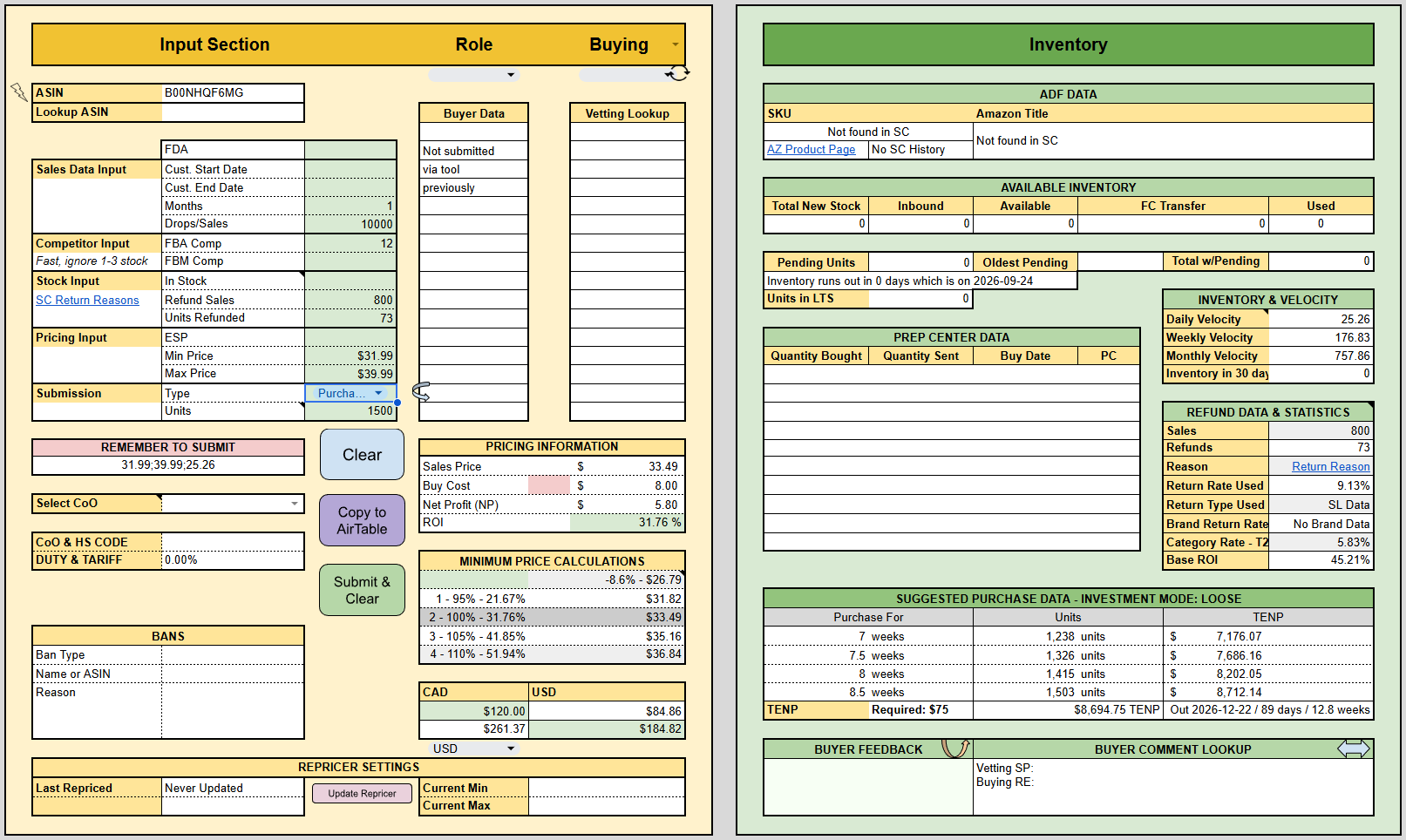
WHAT GETS ANALYZED
Follow a product from lead to purchase.
Understand how a sourcing opportunity becomes a buying decision, which inputs carry the most weight, and where incomplete costs, inconsistent rules, or weak feedback loops can distort the outcome.
01
Lead generation & VA workflow
Examine how leads are found, screened, documented, handed off, and rejected, including whether different people are applying the same standards consistently.
02
Buy / no-buy criteria
Review the thresholds and decision rules used to approve purchases, including profit, ROI, sales velocity, risk signals, and any exceptions that have accumulated over time.
03
True cost inputs
Test whether purchase decisions reflect the costs that actually follow the buy, including prep, inbound costs, and other operational inputs relevant to the business.
04
Return & recovery risk
Bring historical return behavior and inventory recovery into the decision process so repeated losses by product, brand, or category can influence future sourcing.
05
Replenishment logic
Where relevant, examine how repeat orders account for sales velocity, lead times, stock on hand, purchasing constraints, and the trade-off between stockouts and excess inventory.
06
Feedback loops
See whether actual outcomes make their way back into sourcing rules, so the process gets smarter as the business accumulates more purchasing and performance history.
THE BUSINESS CONSEQUENCE
A sourcing process is only as good as the inputs behind it.
As a business grows, sourcing criteria often accumulate in spreadsheets, VA instructions, software settings, and individual judgment. Cost assumptions can go stale. Exceptions become normal. A product that clears the screen today may perform very differently after prep, inbound costs, returns, and recovery are considered.
The useful question is whether the process learns from what happens after the purchase. Historical product, brand, and category performance should make future decisions more informed, especially when similar opportunities appear again.
- Are VAs and buyers evaluating opportunities against the same decision rules?
- Are the real operational costs included before a purchase is approved?
- Which products, brands, or categories repeatedly underperform after purchase?
- How does historical performance change the next buying decision?
- Does replenishment account for velocity, lead time, inventory, and purchasing constraints?
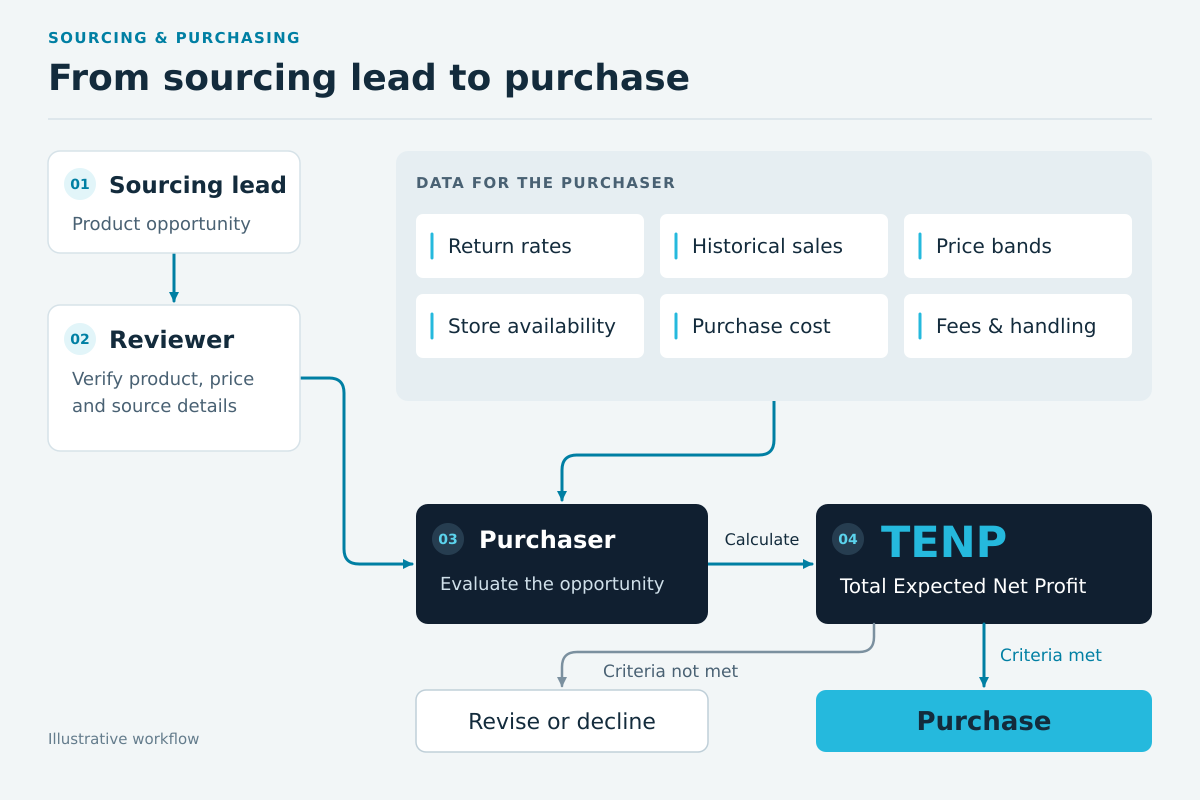
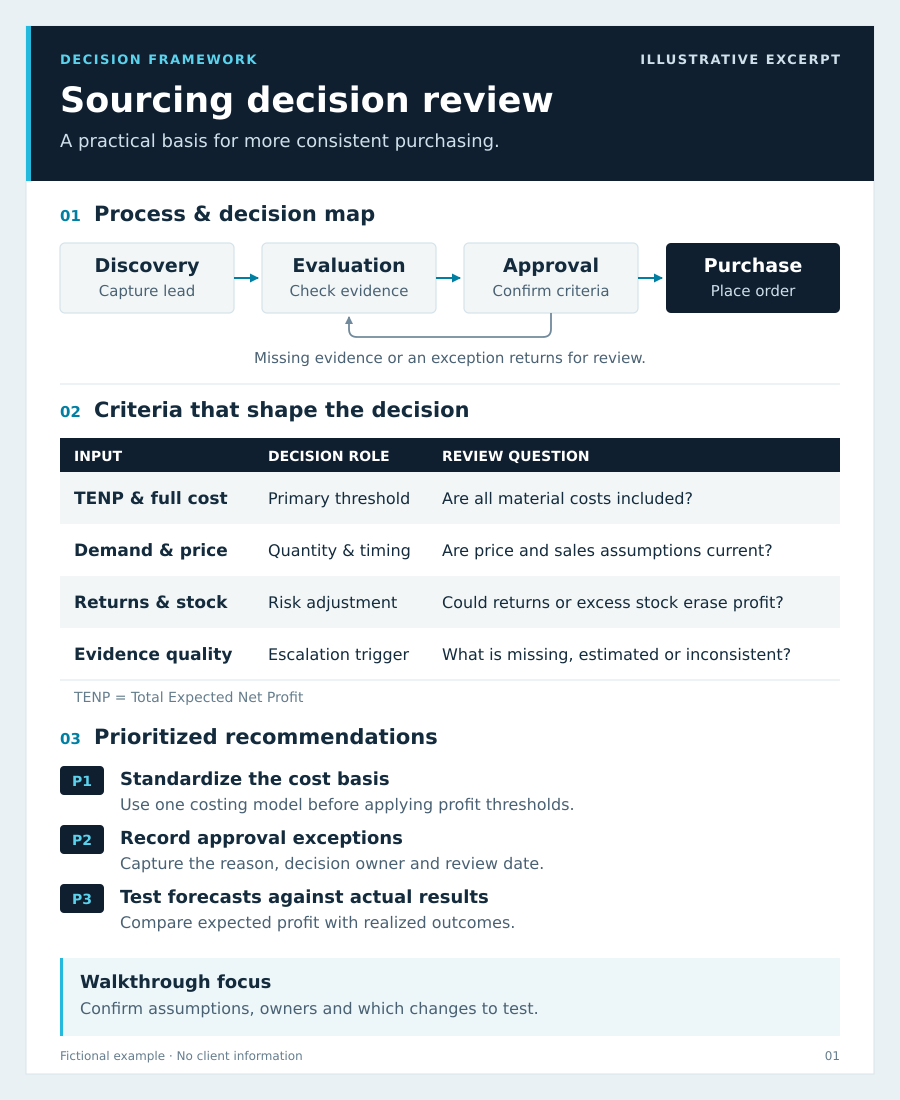
WHAT YOU RECEIVE
A sourcing process you can explain and improve.
Leave with a clearer picture of how decisions are being made today, which inputs deserve more weight, and where the process can be tightened without turning it into an unusable rulebook.
01
Process & decision map
A practical view of how opportunities move from discovery through evaluation, approval, and purchase, including important handoffs, decision points, and exceptions.
02
Criteria analysis
A review of the numbers and rules used to evaluate opportunities, with attention to missing costs, thresholds, risk signals, and inconsistent application.
03
Prioritized recommendations
A focused set of changes, tests, and follow-up questions ranked by their likely importance to the quality and consistency of purchasing decisions.
04
Walkthrough
A final meeting to explain the findings, challenge assumptions, answer questions, and make sure the recommended changes are understood before your team decides what to implement.
HOW IT WORKS
Start with a real decision, then trace the process.
The analysis is built around how your team actually sources and buys, using real examples and available data to understand the process as it operates today.
01
Initial conversation
Walk through one or more recent sourcing or purchasing decisions and identify the questions you want the analysis to answer.
02
Process & data request
Provide the relevant workflow, sourcing criteria, examples, purchasing records, and performance data needed for the agreed scope.
03
Independent analysis
Trace the decision logic, test assumptions against available results, and identify where the process is strong, inconsistent, or missing useful information.
04
Findings & walkthrough
Receive the findings and recommendations, then review what should stay, change, or be tested next.
You keep control of sourcing and purchasing; this engagement examines and improves the decision system behind them.
BEST FIT
Best for businesses making purchasing decisions at scale.
This service is most useful when sourcing has become a repeatable team process involving multiple people, tools, suppliers, or recurring buying decisions.
A strong fit when…
- You use VAs, buyers, or analysts to find and evaluate opportunities.
- Your team reviews enough products that consistency matters.
- Buying decisions rely on spreadsheets, software, manual rules, or combinations of them.
- You suspect important cost or return information is missing from the decision.
- Replenishment or repeat purchasing would benefit from stronger historical feedback.
Scope & boundaries
This is an analytical and advisory engagement. It does not include sourcing products on your behalf, negotiating with suppliers, managing employees, or running day-to-day purchasing or inventory. Implementation support can be scoped separately where it makes sense.
The scope can focus on one part of the process or follow the full path from sourcing lead to repeat purchase.
WHAT BETTER INPUTS CAN CHANGE
Buying decisions improve when the inputs improve.
These examples come from prior analysis and operating work. Details are generalized or anonymized where appropriate.
15%
ROI improvement
Return data changed what was worth buying.
ROI increased by approximately 15% after return performance was incorporated into sourcing decisions and purchasing shifted away from weaker brands, retailers, and categories.
4×+
Cost input
A small prep assumption was materially wrong.
In one analysis, modeled prep cost per unit ended up more than four times the initial working estimate. A cost input that looks minor can change whether a purchase clears the required profit threshold.
$100K+
6-month loss
One brand carried six-figure losses.
Analysis identified more than $100,000 in losses tied to one underperforming brand in a six-month period. That historical pattern is exactly the kind of evidence a sourcing process should feed back into future buying decisions.
COMMON QUESTIONS
The details people usually want to know.
The exact scope depends on the process you want examined, but these are the questions that usually come up first.
Do you source products for us?
No. This service examines and improves the process your business uses to find, evaluate, and purchase opportunities. Your team remains responsible for sourcing products and making the final buying decisions.
Can you review our VA sourcing process?
Yes. The review can follow how VAs find leads, which criteria they apply, how opportunities are documented and handed off, where decisions are escalated, and whether the process is being applied consistently.
Can replenishment be included?
Yes, when replenishment is part of the question you want answered and the necessary information is available. The analysis can examine how repeat orders use sales velocity, lead times, inventory levels, purchasing constraints, and historical performance.
What information do you need?
Usually the current sourcing workflow, decision criteria, examples of recent purchases or rejected opportunities, relevant purchasing records, and the performance or cost data needed to test the assumptions behind those decisions. The exact request is set after the initial conversation.
Can this be a standalone engagement?
Yes. Sourcing & Purchasing Analysis can be scoped around a specific process without requiring a full Amazon Operations Analysis. If the findings point to a broader operational question, that can be discussed separately.
Is this only for Amazon businesses?
Amazon wholesale and resale operations are the strongest fit today because that is where my operating experience is deepest. Other sourcing and purchasing environments can be considered when the process, economics, and available data make the work useful.
START WITH A REAL DECISION
How confident are you in what gets bought?
If your sourcing process has grown across VAs, buyers, spreadsheets, software, and accumulated rules, a focused analysis can show where the decisions are strong and where better inputs or clearer controls could improve them.
Start with one recent purchase, one rejected opportunity, or one part of the process you want to understand better.