OPERATIONAL ANALYSIS & IMPROVEMENT
See where your operation is costing you time, money, and control.
Growth leaves traces: workarounds, duplicated steps, unclear ownership, disconnected tools, and processes that made sense when the business was smaller.
This analysis follows how work actually moves through the business, identifies where friction and risk have accumulated, and separates meaningful problems from background noise.
The goal is a clearer operating picture and a practical set of priorities for what should stay, change, or be investigated next.
Built for growing businesses that have outgrown informal processes but do not need another layer of generic management advice.
WHAT GETS ANALYZED
See how work moves through your business.
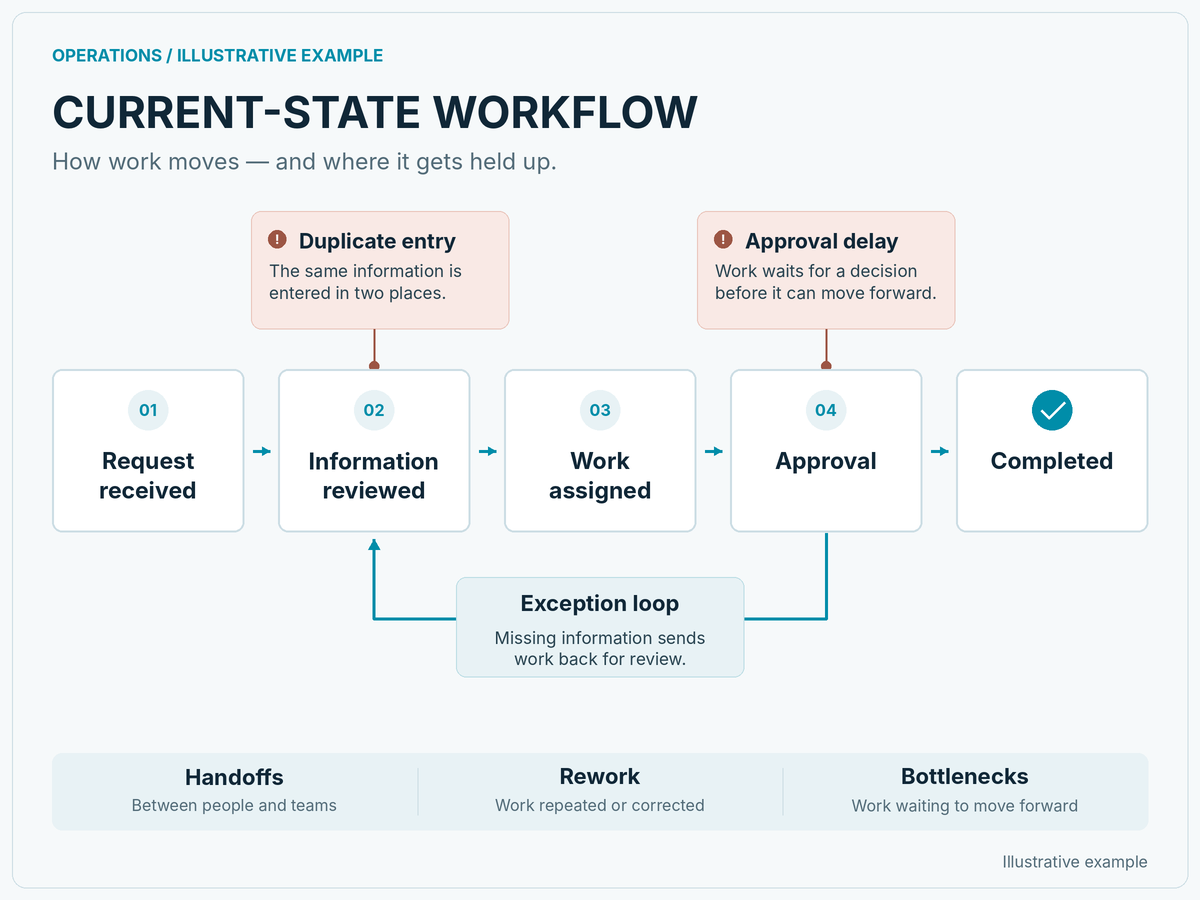
The analysis looks at how work is actually performed: who touches it, what information they use, where it moves next, what gets repeated, and where the process depends on assumptions or individual memory.
01
Process flow
Map how work moves from trigger to completion and compare the documented process, if one exists, with what people actually do day to day.
02
Handoffs & ownership
Identify unclear responsibilities, dropped handoffs, approval bottlenecks, and work that depends on someone knowing what happens next without a reliable system behind it.
03
Rework & duplication
Find steps that are repeated, manually recreated, checked multiple times, or completed in parallel because people or systems do not share the same information.
04
Systems & data
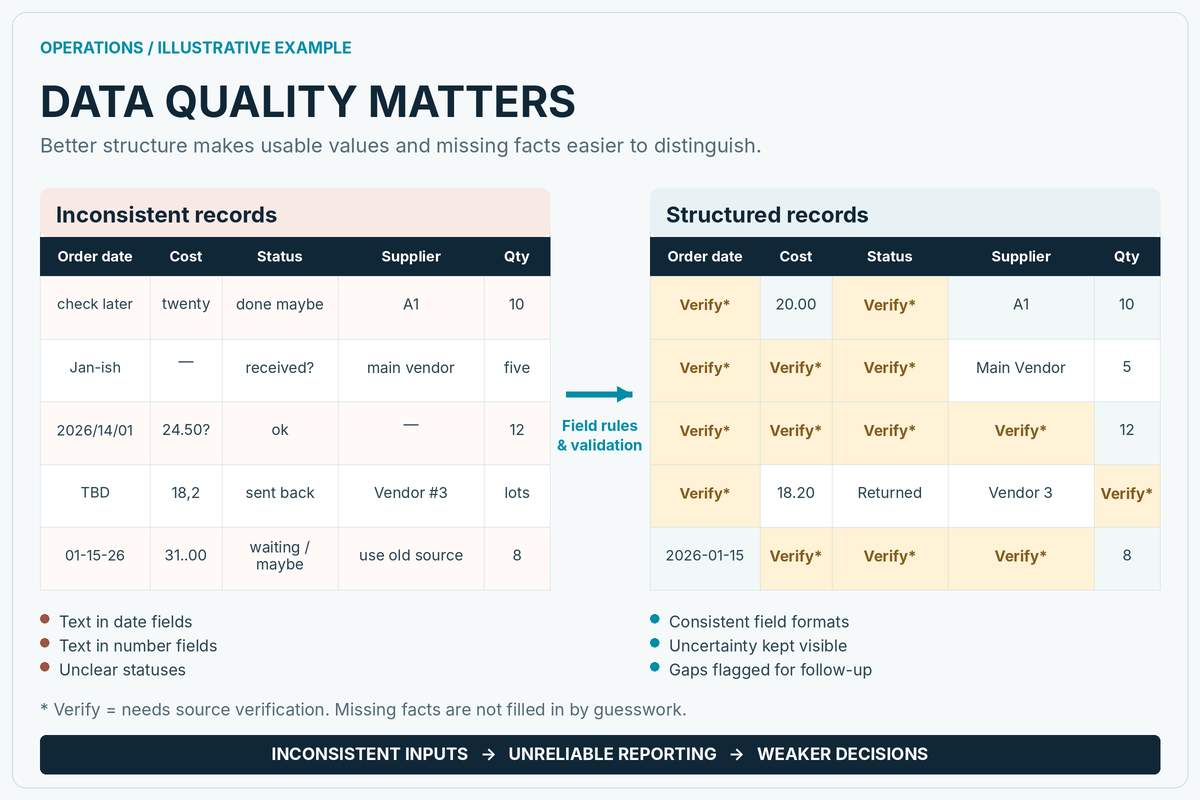
Examine whether spreadsheets, software, status fields, reports, and other tools support the process—or create extra work, inconsistent records, and avoidable uncertainty.
05
Cost & capacity
Where the data supports it, quantify the labour, delay, handling, error, or other operating costs attached to a process so priorities are based on impact rather than annoyance.
06
Controls & resilience
Identify single points of failure, weak controls, undocumented knowledge, and processes that work only because one particular person knows how to keep them moving.
THE BUSINESS CONSEQUENCE
Operational debt gets more expensive as the business grows.
Small businesses can survive on memory, informal handoffs, and a spreadsheet created for a problem that existed three years ago. Growth changes the economics. More people touch the work, exceptions accumulate, and nobody has complete visibility into every change that has been made.
Eventually, the cost shows up as delay, duplicated effort, inconsistent decisions, weak data, unnecessary labour, or management time spent fixing the same problems repeatedly. The first step is understanding where that debt actually sits.
- Where does work routinely slow down, wait, or get repeated?
- Which processes depend too heavily on one person or one undocumented workaround?
- Where are decisions being made without reliable or consistent information?
- Which temporary fixes quietly became permanent operating procedures?
- Which inefficiencies become materially more expensive as volume grows?
WHAT YOU RECEIVE
A clearer operating picture and a practical path forward.
The output is designed to help management decide what deserves attention first, what can wait, and where a seemingly small process problem is creating a larger business cost.
01
Current-state analysis
A structured view of how the relevant process operates today, including important handoffs, decision points, systems, workarounds, dependencies, and areas where reality differs from the intended process.
02
Findings & impact
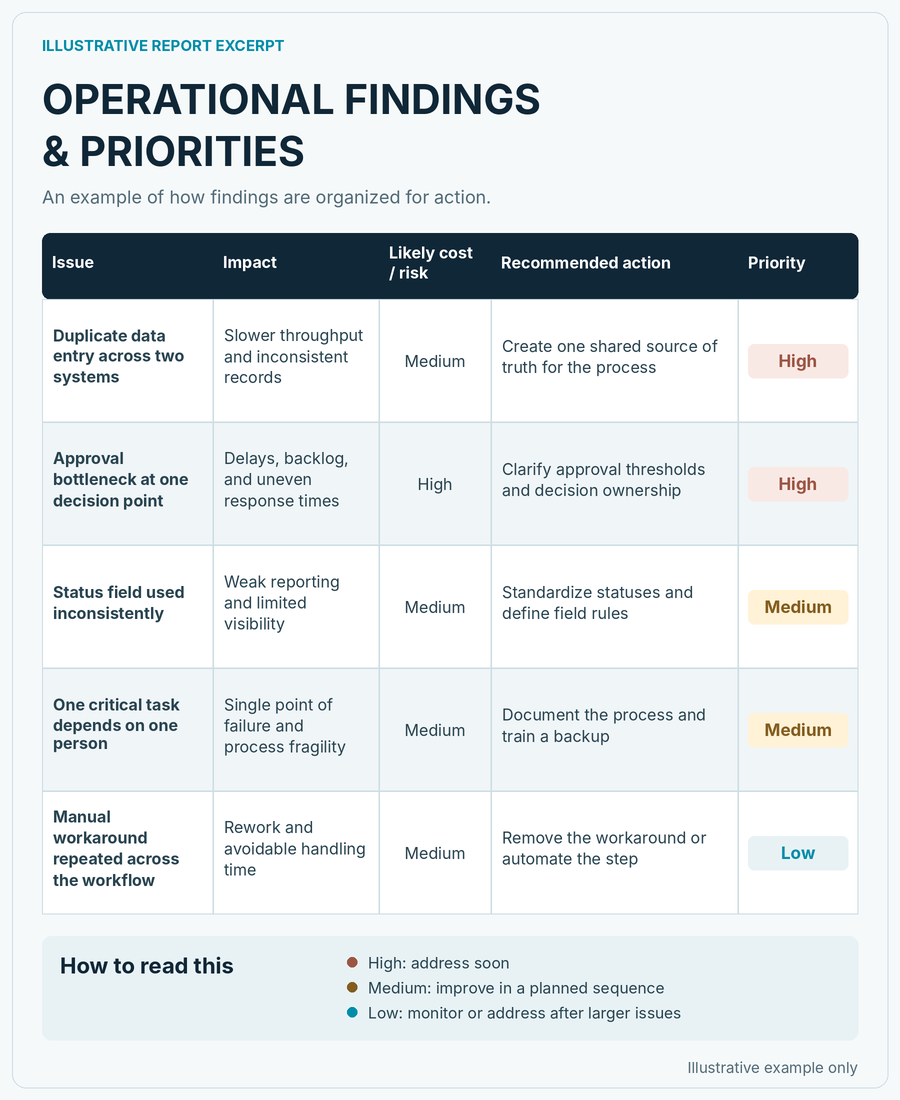
A documented set of operational findings with the likely business impact explained and quantified where the available evidence supports a defensible estimate.
03
Prioritized improvements
A practical order of operations for what to fix, simplify, standardize, measure, or investigate—so effort is directed toward the issues that matter most.
04
Walkthrough
A final meeting to explain the findings, challenge assumptions, answer questions, and make sure management understands both the recommendations and the reasoning behind them.
HOW IT WORKS
Start with the process as it actually exists.
Operational analysis works best when the real workflow is visible. That may require conversations with the people doing the work, examples of recent cases, and the systems or records that support the process.
01
Define the question
Start with the process, concern, or recurring problem management wants to understand and agree on what a useful answer would look like.
02
Observe & gather
Review the relevant workflow, records, systems, examples, and—where useful—speak with the people who actually perform or depend on the work.
03
Analyze the operation
Trace the process, test assumptions, connect the operational and financial context, and identify where friction, risk, rework, or poor visibility is being created.
04
Prioritize the response
Receive the findings and recommendations, then decide which changes deserve immediate attention and which should be tested, monitored, or left alone.
The goal is to understand the work as it is performed—not to judge employees for coping with a process that may have grown around them.
BEST FIT
Best for businesses that have become harder to understand as they grew.
This service is most useful when the business is working, but the systems and processes underneath it have become harder for management to see, explain, or improve with confidence.
A strong fit when…
- Multiple people or teams touch the same process.
- Workarounds and manual steps have accumulated over time.
- Management knows something feels inefficient but cannot isolate the cause or impact.
- Important knowledge lives with individuals instead of in a repeatable process.
- Growth has made old systems, rules, or responsibilities increasingly expensive to maintain.
Scope & boundaries
This is an analytical and advisory engagement. It does not mean taking over day-to-day operations, managing your employees, or becoming your permanent operations manager. Selected implementation work can be scoped separately when it makes sense.
The engagement can focus on one stubborn process or a broader operating area, depending on the question you need answered.
SELECTED OPERATING RESULTS
Better operating information can change what happens next.
Examples below come from prior operating and analytical work. They illustrate the kinds of business consequences that can become visible when processes, costs, and decisions are examined together.
2×+
Revenue growth
A shutdown project became a growth story.
I was initially brought into an Amazon business that was expected to wind down. Instead, I stayed to help run and improve the operation, and revenue subsequently grew by more than two times over the following years.
15%
ROI improvement
Better feedback changed future decisions.
Return analysis was incorporated into purchasing decisions, leading the business to stop or reduce buying from weaker brands, retailers, and categories. ROI improved by approximately 15%.
4×+
Cost gap
A routine cost was materially underestimated.
In one operational analysis, modeled prep cost per unit ended up more than four times the initial working estimate. A small assumption became significant once it was multiplied across the operation.
91.9d
Days to sell
Sell-through needed a measurable baseline.
A detailed inventory analysis established an average of 91.9 days to sell, creating a concrete baseline for evaluating inventory age, storage exposure, purchasing behaviour, and when intervention may be warranted.
COMMON QUESTIONS
The details people usually want to know.
Every operation is different, but the same practical questions usually come up before deciding whether an analysis makes sense.
What kinds of processes can you analyze?
Any business process where the work can be observed, explained, and supported by enough evidence to evaluate it responsibly. Examples include purchasing, handoffs, approval flows, warehouse processes, recurring administrative work, data flows, and decision-making systems.
Do you need to interview employees?
Sometimes. The people doing the work often understand the real process better than the documentation does. Interviews are used to understand how the process operates, where friction occurs, and what workarounds have developed—not to conduct employee performance reviews.
Do we need clean data before starting?
No. Messy data can itself be part of the operational problem. The available evidence still has to be sufficient for the questions being asked, and conclusions will be limited where the records do not support a confident answer.
Do you implement the recommendations?
The core engagement is analysis and advisory work. Selected implementation support may be available afterward on a separate scope, but the default is to leave management with clear findings, priorities, and recommendations rather than become part of the permanent operating team.
Is this fractional operations management?
No. The service is designed to examine and improve how the operation works, not to manage the business day to day. A separate fractional engagement could be considered in a specific situation, but it is not the standard offer.
Can we focus on one specific problem?
Yes. A tightly defined process or recurring operational problem can be a better starting point than a broad review. Scope is set around the question you need answered and the evidence required to answer it well.
START WITH THE PROBLEM
What part of the operation is harder to explain than it should be?
If a process keeps creating delays, rework, uncertainty, or management attention—and nobody can clearly explain why—start there. A focused analysis can establish what is actually happening before you spend time or money trying to fix it.
Bring one process, one recurring problem, or one area of the business you want to understand better.