AMAZON OPERATIONS ANALYSIS
Know what your Amazon business actually earns.
A purchase can meet your ROI target on paper and earn less than expected once prep, returns, and other operating costs are included.
I connect your Amazon reports with your cost and operating data to show how products, brands, and categories perform. The findings help you quantify costs you may still be estimating and decide what should change in your sourcing criteria.
Best suited to established Amazon businesses, typically around $2M+ in annual revenue, with enough volume and complexity for deeper analysis.
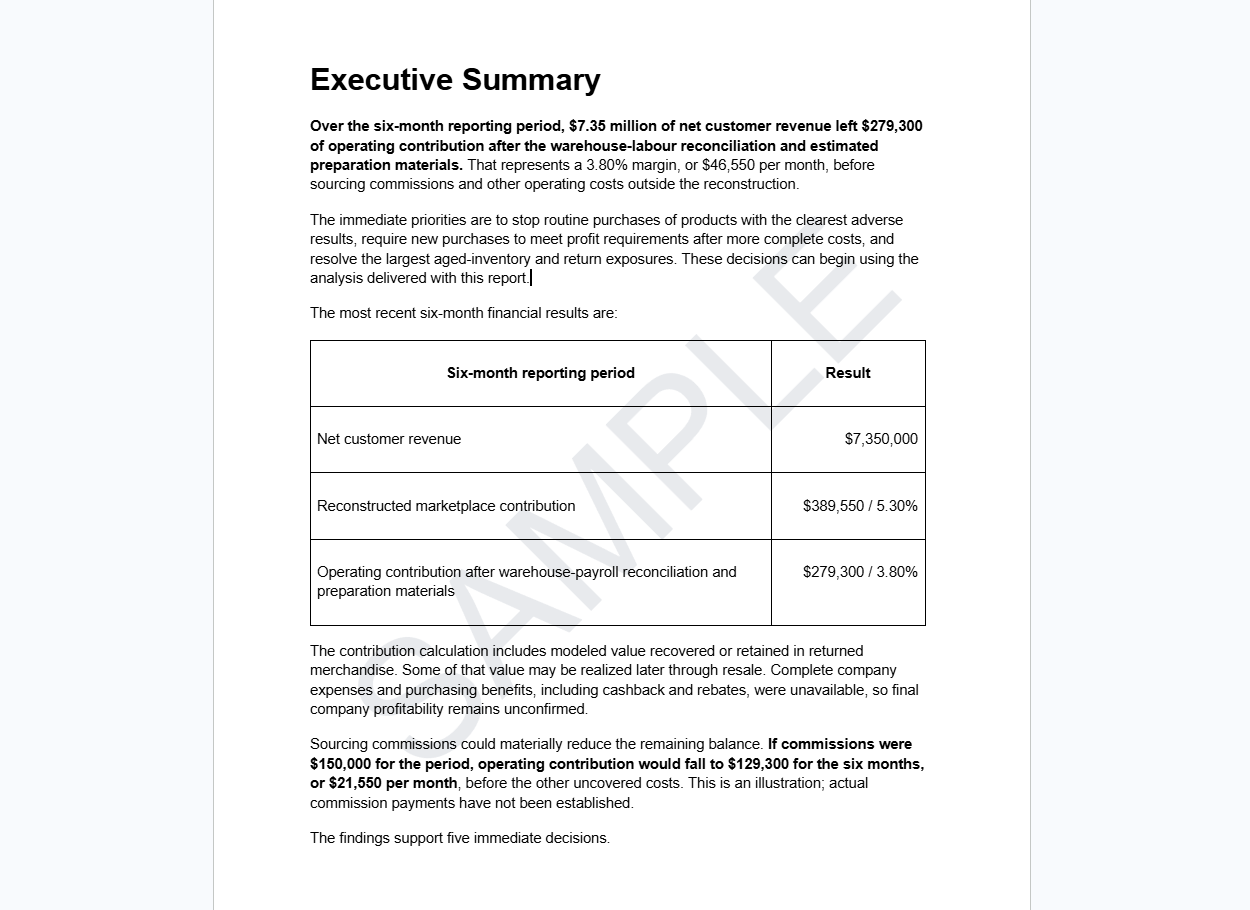
WHAT THIS COVERS
The costs and performance behind your buying decisions
A small cost repeated across thousands of units can become material. As your volume and product mix change, prep, return handling, recovery, and sell-through can also change which purchases meet your targets.
- Which products, brands, or categories lose value once returns and recovery are included?
- What does one prepared unit actually cost before it reaches Amazon?
- How much inventory value is actually recovered after a customer return?
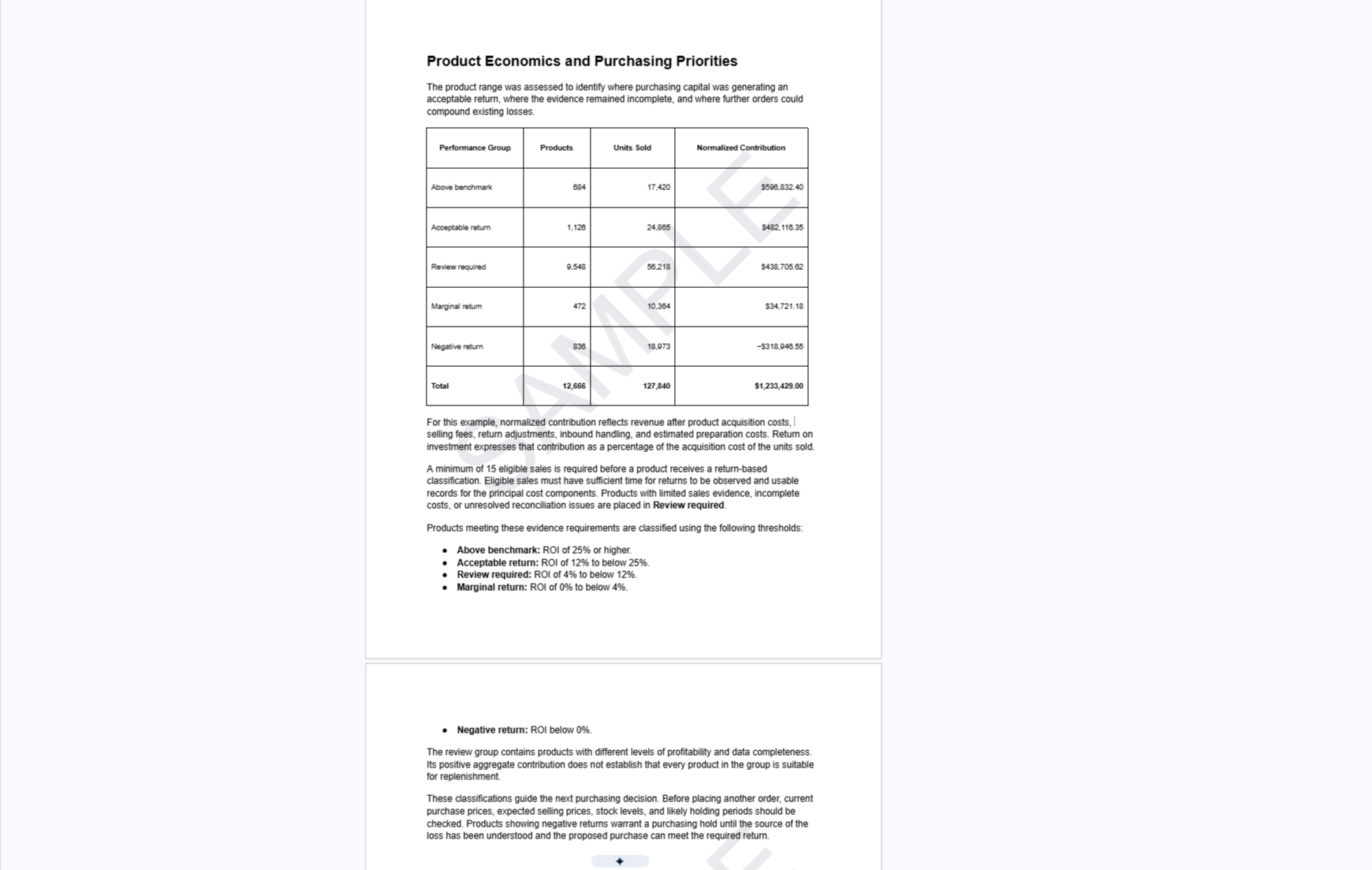
I examine the following areas, with the depth of the work determined by the agreed scope and available data.
01
True profitability
See how products, brands, and categories perform after relevant operating costs are included. Where the data supports it, I can examine performance beyond root categories, down to deeper category tiers.
02
Returns & recovery
Look at return rates alongside the cost of handling returned units and the inventory value recovered. A return’s economic impact depends on what happens to the unit after it comes back.
03
Prep & handling
Model the cost of preparing and processing a unit using available labour, throughput, and operating data. This gives you a cost estimate grounded in how the work is done.
04
Inventory & sell-through
Where the data supports it, identify slow-selling products and examine how aging inventory, storage costs, and sell-through affect their profitability.
05
Operational costs
Bring relevant inbound, storage, return-handling, and other operating costs into the analysis, including costs recorded separately from your Amazon reports.
06
Sourcing decisions
Use historical performance to review your buying criteria: what to keep buying, what deserves a higher threshold, and which opportunities no longer meet your targets once the relevant costs are included.
SELECTED FINDINGS
What I’ve found in Amazon businesses
I started selling on Amazon in 2017, went on to help operate an Amazon business, and have advised other companies on their operations.
These examples come from prior analysis and operating work. Details are generalized or anonymized to protect client and business information.
4×+
Prep cost
Prep cost was more than four times the working estimate.
In one engagement, I modeled labour and throughput to establish the per-unit prep cost. The result was more than four times the estimate used in buying decisions. At that modeled cost, some previously approved purchases would have fallen below the client’s buying threshold.
$100K+
Six months
One brand had generated more than $100,000 in losses over six months.
The client already knew the brand was underperforming. Quantifying the losses showed the scale of the problem and gave future sourcing decisions a clearer basis.
15%
ROI gain
Return data helped produce a 15% relative gain in ROI.
In an Amazon business I helped operate, incorporating return performance into sourcing decisions contributed to a 15% relative improvement in ROI as buying shifted away from weaker brands, retailers, and categories.
10×
Return handling
Return handling cost roughly ten times the modeled prep cost.
In one analysis, the per-unit cost of handling a return was far higher than the modeled cost of preparing the unit. For high-return products, that could materially change which ones were worth buying.
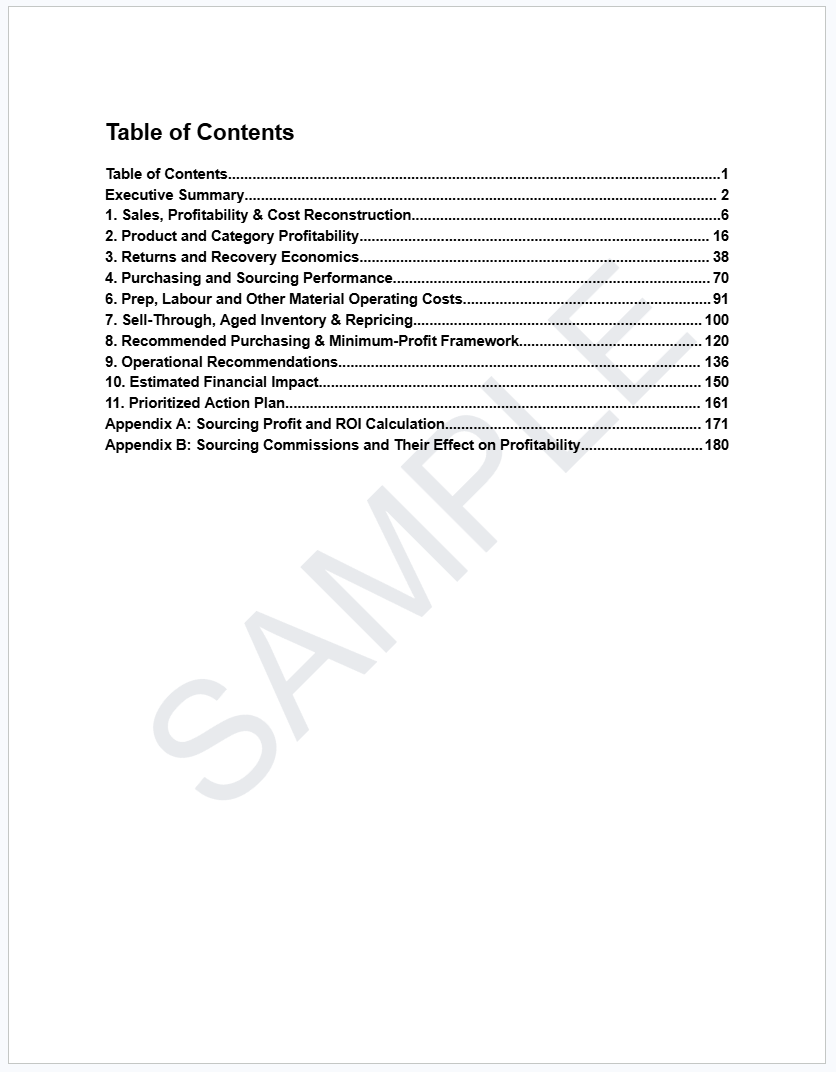
WHAT YOU RECEIVE
Analysis you can make decisions from
You receive the findings and the supporting calculations, with recommendations for what to address first.
01
Written findings report
A detailed report explaining what I found and how it affects the business, with financial estimates where the evidence supports them.
02
Supporting analysis
Structured spreadsheets and analytical work that let you explore product, brand, category, and operational performance beyond the report’s conclusions.
03
Prioritized recommendations
Practical recommendations on what to change, what to stop, what needs further investigation, and which findings should inform future buying decisions.
04
Walkthrough
A final meeting to work through the findings, answer your questions, and explain the conclusions and their implications.
HOW IT WORKS
A clear process with minimal disruption to your team
01
Initial conversation
We discuss your business, your concerns, and the questions you most want answered. From there, we agree on the scope, price, and expected timeline.
02
Information request
I send you a defined request for the exported Amazon reports and supporting cost or operational information needed for the agreed scope. No Seller Central access is required.
03
Independent analysis
I connect the reports with your cost and operating data, then test the assumptions behind the numbers. I work independently, so the process does not depend on recurring meetings. I keep you updated and ask follow-up questions when I need more context.
04
Findings & walkthrough
You receive the report, supporting analysis, and recommendations. We then review the conclusions together and discuss what they mean for your business.
WHO IT IS FOR
For established Amazon businesses with recurring sourcing decisions
The full analysis is generally most useful where transaction volume and operational complexity justify a detailed review.
It is a good fit when:
- Wholesale, resale, or mixed catalogues create recurring sourcing decisions across meaningful product volume.
- Return behaviour, recovery, prep, inventory, or other operating costs are not fully quantified.
- Management wants product, brand, or category decisions grounded in historical performance.
- The business can provide the Amazon reports and supporting operating data needed for the agreed scope.
Smaller or very simple operations may not have enough complexity for a full analysis to justify the investment.
Scope and boundaries
This service covers analysis and advisory work. It does not cover PPC, SEO, listing optimization, account health, reimbursements, bookkeeping, tax work, supplier negotiation, or day-to-day inventory management. Implementation support may be considered separately on a case-by-case basis.
Common questions
Do you need access to my Seller Central account?
No. I use exported Amazon reports and the supporting operational information supplied for the agreed scope. I neither need nor request your Seller Central login credentials.
What information will you need from us?
At minimum, the relevant Amazon reports and cost information needed to answer the agreed questions. Deeper work may require purchasing, labour, shipping, 3PL, or other operating data.
Supplier names can often be anonymized when their identity is not relevant to the analysis. Aggregate departmental labour costs are generally more useful than employee-level payroll detail.
What if we already use profitability software?
That can be a useful starting point. I examine the assumptions and operating costs behind its figures and connect information held across Amazon reports and your internal records. This helps establish whether the inputs reflect how your operation actually works.
What size business is this designed for?
The full analysis is generally most useful for established Amazon businesses doing around $2 million or more in annual revenue. Revenue is a guide, and SKU count, transaction volume, business model, operational complexity, and data quality also affect fit and scope.
How long does an analysis take?
The typical target is roughly two to three weeks after I receive the complete required data. Timing can change with scope, record volume, and data quality. We agree on the expected timeline before the engagement begins.
What does a full analysis cost?
Full Amazon Operations Analysis engagements start at US$10,000. Final pricing depends on scope and complexity, including the volume and quality of the available data. We agree on the final scope and price before work begins.
Start with the question you need answered
You may want to understand why a brand is underperforming, establish a reliable prep cost, or decide whether your buying criteria need to change. We can start with that question and see whether an analysis would help.
I complete each analysis personally, one engagement at a time.